

This page validates the calculation of ground heat collectors in nPro. The validation is carried out in three stages: verification of the calculation core against exact analytical limiting cases, comparison with the reference case of a doctoral thesis from TU Dresden, and comparison with the design values of VDI 4640 Part 2 for all 15 climate zones in Germany and four soil types.
The calculation methodology used in nPro (heat conduction, ice formation, hydraulics, design criteria and reasonable input values) is described on the page Design of ground heat collectors: calculation methodology.
Overview of results
The collector calculation in nPro agrees well with the reference literature and is on the safe side. The calculation core reproduces analytical solutions with an accuracy of about 0.01 %. In the reference case of the TU Dresden study, the ice radius and the onset of ice formation agree closely, and the design leads to the same result. Across the climate zones and soil types of VDI 4640 Part 2, the results correlate with r = 0.98. On average, nPro calculates a 6 to 9 % lower permissible heat extraction rate than the VDI guideline, i.e. its design is slightly conservative.
| Validation | Compared quantity | Result |
|---|---|---|
| Analytical limiting cases | Steady-state thermal resistance and short-term response | Deviation approx. 0.01 % (steady state), below 0.01 K per W/m (short term) |
| Doctoral thesis TU Dresden | Ice radius, ice formation, permissible heat extraction rate | Ice radius 0 - 10 % larger, identical design (25 W/m² permissible, 35 W/m² not permissible) |
| VDI 4640 Part 2, Table A2 | Max. heat extraction rate, 15 climate zones × 4 soil types | Cohesive soils -9 % on average, sand -6 % on average (slightly conservative) |
Verification of the calculation core against analytical limiting cases
The nPro calculation core solves the heat conduction around a row of parallel collector pipes below the ground surface in the frequency domain. For two limiting cases, independent exact solutions exist that can be used to verify the numerical implementation.
Steady-state limiting case
For a permanently constant heat extraction rate, the thermal resistance of a row of pipes below an isothermal surface is given in closed form (shape factor according to the VDI Heat Atlas, see calculation methodology). nPro does not calculate this value directly but as the limit of the frequency solution. The agreement shows that the series expansion and the image sources are implemented correctly.
| Thermal conductivity | Installation depth | Pipe spacing | Outer pipe diameter | nPro | Analytical | Deviation |
|---|---|---|---|---|---|---|
| 1.5 W/(mK) | 1.2 m | 0.6 m | 32 mm | 1.5230 (mK)/W | 1.5229 (mK)/W | 0.008 % |
| 1.5 W/(mK) | 1.5 m | 0.3 m | 25 mm | 3.4758 (mK)/W | 3.4755 (mK)/W | 0.009 % |
| 2.0 W/(mK) | 1.2 m | 0.8 m | 20 mm | 0.9525 (mK)/W | 0.9525 (mK)/W | 0.002 % |
| 1.2 W/(mK) | 1.0 m | 0.5 m | 32 mm | 1.8796 (mK)/W | 1.8794 (mK)/W | 0.012 % |
Short-term behaviour
Immediately after switching on, each collector pipe behaves like a single line source in an infinite medium, because the temperature change has not yet reached the neighbouring pipes and the ground surface. This solution (Kelvin line source) is also used in the nPro borehole model according to Koenigsdorff for the peak load. For a 12-hour heat extraction of 1 W/m, nPro yields the same temperature drop as the line source.
| Time after start | nPro | Line source | Deviation |
|---|---|---|---|
| 1 h | 0.110 K | 0.118 K | -0.008 K |
| 2 h | 0.189 K | 0.185 K | 0.004 K |
| 4 h | 0.232 K | 0.230 K | 0.002 K |
| 8 h | 0.272 K | 0.270 K | 0.002 K |
| 12 h | 0.291 K | 0.293 K | -0.002 K |
Between these two limiting cases (hours and years), nPro calculates the transition exactly from the same solution. Short-term load peaks, the annual cycle and the base load are thus superimposed consistently and with the correct time shift.
Validation with a doctoral thesis from TU Dresden
A doctoral thesis at TU Dresden contains an analytical calculation model for ground heat collectors with ice formation. According to the guideline, the design values of VDI 4640 Part 2 for ground heat collectors are the result of numerical optimizations based on this study. nPro uses comparable approaches for the ice geometry and for heat conduction through the frozen soil, but calculates heat conduction in the unfrozen soil independently using an exact frequency solution. The comparison therefore mainly checks whether both models arrive at the same result for the interaction of heat conduction and ice formation.
Definition of the reference case
| Installation depth | Pipe spacing | Collector pipe | Temperature spread | Thermal conductivity | Thermal diffusivity | Annual mean air temp. | Air temp. amplitude | Heating limit temp. | Design outdoor temp. |
|---|---|---|---|---|---|---|---|---|---|
| 1.2 m | 0.6 m | PE 32 × 2.9 mm | 3 K | 1.45 W/(mK) | 6.0·10-7 m²/s | 7.9 °C | 9.9 K | 12 °C | -16 °C |
The heating load increases linearly from the heating limit temperature to the design outdoor temperature, resulting in 1713 full-load hours. Three area-specific heat extraction rates of the heat pump are examined: 15, 25 and 35 W/m².
Comparison of ice formation
| Heat extraction rate | Max. ice radius nPro | Max. ice radius reference | Onset of ice formation nPro | Onset of ice formation reference | Ice-free nPro | Ice-free reference |
|---|---|---|---|---|---|---|
| 15 W/m² | 0.22 m | approx. 0.22 m | 15 December | approx. 10 December | 8 May | approx. 7 May |
| 25 W/m² | 0.39 m | approx. 0.37 m | 25 November | approx. 25 November | 17 June | approx. 3 June |
| 35 W/m² | 0.62 m | approx. 0.56 m | 11 November | approx. 12 November | 19 July | approx. 20 June |
The onset and growth of ice formation agree closely. The maximum ice radius is identical at 15 W/m² and up to 10 % larger in nPro at higher extraction rates. At high heat extraction rates, the ice in nPro thaws more slowly in spring. The reference study models the recovery of the soil in spring with a simplified energy balance approach, whereas nPro calculates it from the same heat conduction solution as the winter period. In the design, the slower thawing leads to slightly larger collector areas, i.e. to results on the safe side.
Comparison of the design
The reference study evaluates the three heat extraction rates against the following design criteria: minimum brine temperature, a maximum ice radius of 0.5 m, and ice bridges between the pipes that must have thawed by the start of the growing season.
| Heat extraction rate | Ice bridges thawed nPro | Evaluation nPro | Evaluation reference |
|---|---|---|---|
| 15 W/m² | no ice bridges | permissible | permissible |
| 25 W/m² | 7 May | permissible | permissible |
| 35 W/m² | 15 June | not permissible (ice radius and ice bridges) | not permissible (brine temperature, ice radius and ice bridges) |
If nPro is used to size the collector area for this case itself, the result is a maximum permissible heat extraction rate of 25.2 W/m². The reference study concludes that 25 W/m² meets all design criteria and 35 W/m² does not.
Validation with VDI 4640 Part 2
Table A2 of VDI 4640 Part 2 contains maximum area-specific heat extraction rates for horizontal ground heat collectors in all 15 climate zones of Germany according to DIN 4710 and for four soil types. According to the guideline, the values are the result of numerical optimizations based on the doctoral thesis mentioned above. nPro was used to recalculate all 60 combinations.
Boundary conditions
For each case, the highest heat extraction rate at which all design criteria are met was determined. The boundary conditions correspond to the specifications of VDI 4640 Part 2 and the reference study:
| Parameter | Approach |
|---|---|
| Climate | Annual mean and amplitude of the air temperature at the reference locations according to DIN 4710 |
| Heating load | Increasing linearly from the heating limit temperature of 12 °C, scaled to the full-load hours of the VDI table (1350 - 2400 h/a) |
| Collector | Installation depth 1.2 m, PE 32 × 3.0 mm, pipe spacing in the middle of the VDI range, turbulent flow (Re ≈ 2500 - 3000), temperature spread 3 K |
| Soil | Thermal conductivity, heat capacity and water content per climate zone and soil type according to the reference study (basis of VDI Table A1); freezable water content at -2 °C |
| Criteria | Brine to heat pump ≥ -5 °C, ice bridges thawed by the start of the growing season, max. ice radius 0.5 m (default setting in nPro; for sand see below) |
In all cases, the ice criteria are decisive for the design, not the brine temperature. On/off cycling of the heat pump, which nPro does not model, therefore has no influence on the results. This was additionally checked with a cycling correction (heat pump run time up to 420 minutes): the results are identical.
Results
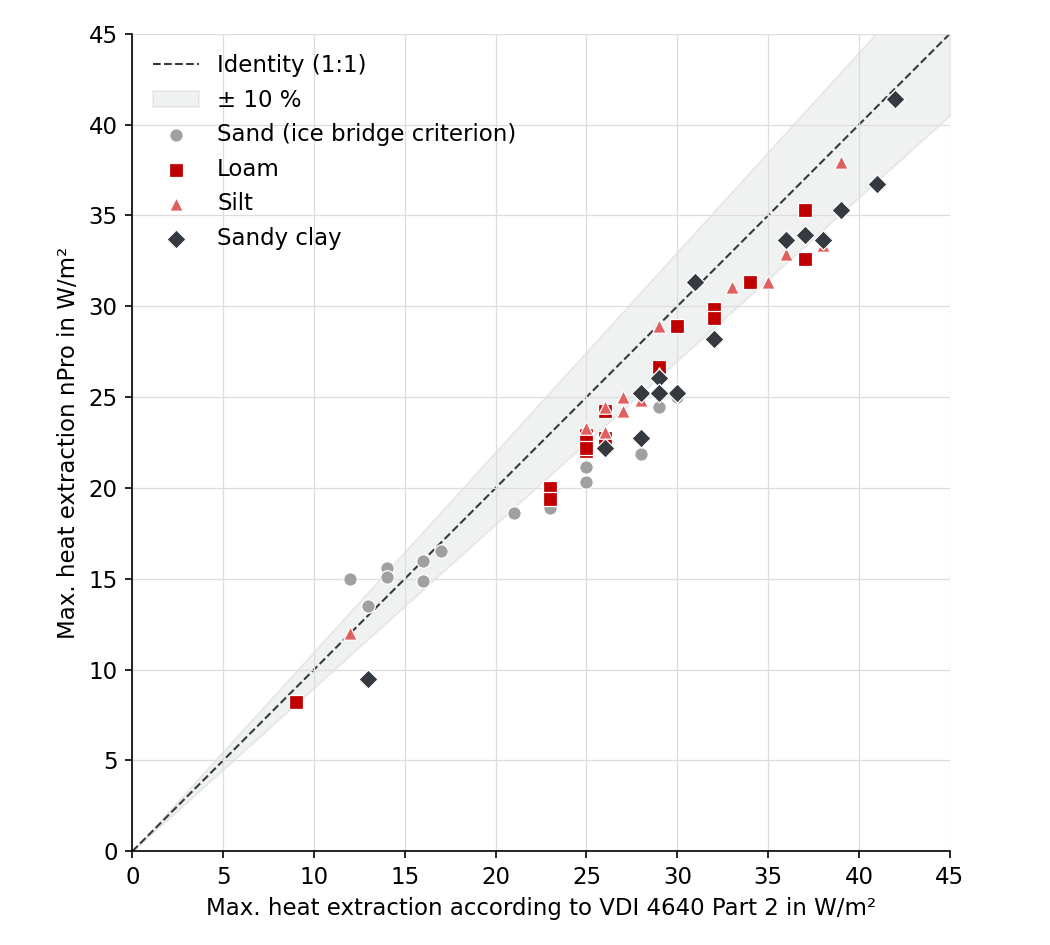
Cohesive soils: loam, silt and sandy clay
| Climate zone | Reference location | Loam VDI | Loam nPro | Silt VDI | Silt nPro | Sandy clay VDI | Sandy clay nPro |
|---|---|---|---|---|---|---|---|
| 1 | Bremerhaven | 34 | 31.3 | 36 | 32.9 | 39 | 35.3 |
| 2 | Rostock | 29 | 26.7 | 29 | 28.9 | 31 | 31.3 |
| 3 | Hamburg | 32 | 29.8 | 35 | 31.3 | 38 | 33.6 |
| 4 | Potsdam | 30 | 28.9 | 33 | 31.1 | 36 | 33.6 |
| 5 | Essen | 37 | 32.6 | 38 | 33.4 | 41 | 36.7 |
| 6 | Bad Marienberg | 26 | 22.7 | 28 | 24.8 | 30 | 25.2 |
| 7 | Kassel | 32 | 29.4 | 33 | 31.1 | 37 | 33.9 |
| 8 | Braunlage | 23 | 20.0 | 25 | 23.3 | 26 | 22.2 |
| 9 | Chemnitz | 26 | 24.2 | 29 | 26.3 | 32 | 28.2 |
| 10 | Hof | 23 | 19.4 | 26 | 23.1 | 28 | 22.7 |
| 11 | Fichtelberg | 9 | 8.2 | 12 | 12.0 | 13 | 9.5 |
| 12 | Mannheim | 37 | 35.3 | 39 | 37.9 | 42 | 41.4 |
| 13 | Passau | 25 | 22.9 | 27 | 25.0 | 29 | 26.1 |
| 14 | Stötten | 25 | 22.0 | 27 | 24.2 | 28 | 25.2 |
| 15 | Garmisch-Partenkirchen | 25 | 22.2 | 26 | 24.4 | 29 | 25.2 |
| Soil type | Mean deviation | Range |
|---|---|---|
| Loam | -9 % | -16 % to -4 % |
| Silt | -7 % | -12 % to 0 % |
| Sandy clay | -11 % | -27 % to +1 % |
Sand
Sand contains little water (below 10 vol.%). For the same amount of heat, a much larger volume of soil therefore freezes than in cohesive soils, and the ice radius becomes large. In the default setting, nPro additionally limits the ice radius to 0.5 m. This criterion is decisive for the design in sand and leads to considerably more conservative values than the VDI table. For the comparison with the VDI guideline, only the criterion of ice bridges thawed by the start of the growing season was therefore applied (adjustable in nPro via a larger maximum ice radius).
| Climate zone | Reference location | Sand VDI | Sand nPro | Deviation |
|---|---|---|---|---|
| 1 | Bremerhaven | 28 | 21.8 | -22 % |
| 2 | Rostock | 21 | 18.6 | -11 % |
| 3 | Hamburg | 25 | 21.2 | -15 % |
| 4 | Potsdam | 23 | 18.9 | -18 % |
| 5 | Essen | 29 | 24.4 | -16 % |
| 6 | Bad Marienberg | 16 | 16.0 | 0 % |
| 7 | Kassel | 25 | 20.3 | -19 % |
| 8 | Braunlage | 12 | 15.0 | +25 % |
| 9 | Chemnitz | 17 | 16.5 | -3 % |
| 10 | Hof | 13 | 13.5 | +4 % |
| 12 | Mannheim | 30 | 25.0 | -17 % |
| 13 | Passau | 16 | 14.9 | -7 % |
| 14 | Stötten | 14 | 15.6 | +12 % |
| 15 | Garmisch-Partenkirchen | 14 | 15.1 | +8 % |
On average, nPro is 6 % below the VDI values for sand (range -22 % to +25 %). For climate zone 11 (Fichtelberg), this comparison is not possible because the monthly mean air temperature there never reaches the growing season threshold of 12 °C. With the default setting (max. ice radius 0.5 m), nPro yields more conservative values for sand. We recommend this setting as a safe basis for planning.
Assessment
The nPro results follow the VDI values very consistently across all climate zones and soil types (correlation r = 0.98). The dependence on climate is reproduced correctly: from the mild zones along the Rhine and the coast to the Fichtelberg with values around 10 W/m², both calculations run in parallel.
For the cohesive soils loam, silt and sandy clay, nPro is on average 9 % below the VDI values, and for sand 6 % on average. The main reason is the somewhat slower thawing of the ice bridges in spring, which was already observed in the reference case of the reference study. A collector designed with nPro is therefore slightly larger than according to the VDI table and has a safety margin.
Overall, the comparison confirms that nPro delivers consistent results on the safe side compared with the design values of VDI 4640 Part 2 for different combinations of climate, soil type, pipe spacing and full-load hours. Compared with the table, nPro has the advantage that it calculates with the actual hourly load profile, the weather at the specific site and any pipe spacing and pipe size, and that it outputs brine temperatures, ice development and hydraulics in addition to the collector area.
Sources
- VDI guideline 4640 Part 2: “Thermal use of the underground - Ground source heat pump systems”. Verein Deutscher Ingenieure, 2019.
- DIN 4710: “Statistiken meteorologischer Daten zur Berechnung des Energiebedarfs von heiz- und raumlufttechnischen Anlagen in Deutschland” (Statistics on German meteorological data for calculating the energy demand of heating and air-conditioning systems).
- VDI-Wärmeatlas (VDI Heat Atlas), chapter Ea: Heat conduction (shape factors).