

On this page you will learn how to use the specification of a merit order in nPro to define the deployment of your heat generators manually and on a rule basis instead of through the optimization. Using two practical examples – bivalent heat pump operating modes and CHP priority control – we show how real operating strategies can be represented.
What is the merit order in nPro?
By default, the optimization in nPro automatically determines for each time step which heat generator supplies how much heat – in accordance with the chosen objective, for example minimum costs or minimum emissions.
In practice, however, many plants do not follow a purely economic logic, but a fixed, non-predictive ranking that results from technical, regulatory or operational reasons: bivalence points in hybrid heating systems, priority rules for CHP plants or contractually guaranteed coverage shares. Such cases can only be represented via the optimization with increased modelling effort and partly artificially set constraints.
With the merit order, you represent exactly this kind of operation: you decide yourself in which sequence the generators step in, and refine this via further boundary conditions. Only once a higher-priority generator has exhausted its capacity or is blocked by an operational restriction is the next one switched on. Figure 1 shows the corresponding input form.
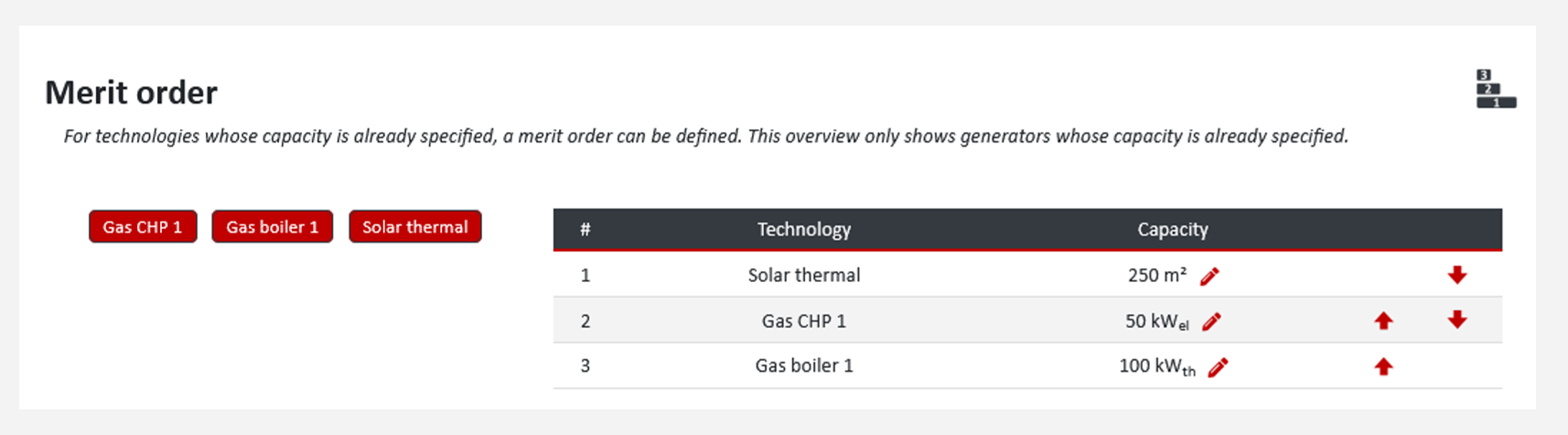
The order is defined in each case for one type of demand, for example for the low-temperature heating demand. The setting can be reached via the operational restrictions of the individual generators or via the general settings menu of the energy center.
Interaction with the operational restrictions
The merit order and the operational restrictions answer two different questions and complement one another:
- The operational restrictions define when a generator is allowed to run at all – for example only above or below a certain outside air temperature, only in certain months or within specified full-load hour limits.
- The merit order defines in which ranking the released generators are called upon to cover the load.
The following examples use both together.
Example 1: bivalent heat pump operating modes
In hybrid heating systems consisting of a heat pump and a fossil-fired or electric supplementary generator, operation is usually controlled via a bivalence point – that outside temperature at which the second generator is switched on. Three operating modes are distinguished (see Figure 2):
- Bivalent alternative: above the bivalence point, the heat pump covers the demand on its own; below it, the second generator takes over exclusively. There is no parallel operation.
- Bivalent parallel: the heat pump runs continuously; below the bivalence point, the second generator covers the additional demand.
- Bivalent partly parallel: between the switch-on and switch-off point, both generators run in parallel, with the heat pump’s share of the capacity decreasing as the outside temperature falls.
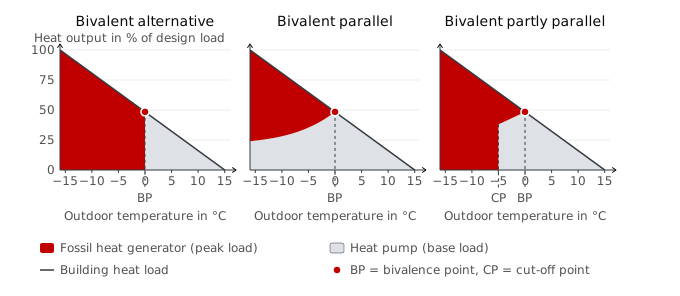
The choice of operating mode has direct consequences for economic feasibility and efficiency: the lower the bivalence point, the larger the heat pump has to be sized and the more frequently it works at low outside temperatures with an unfavorable COP. It is precisely this conflict of objectives that you can calculate in nPro.
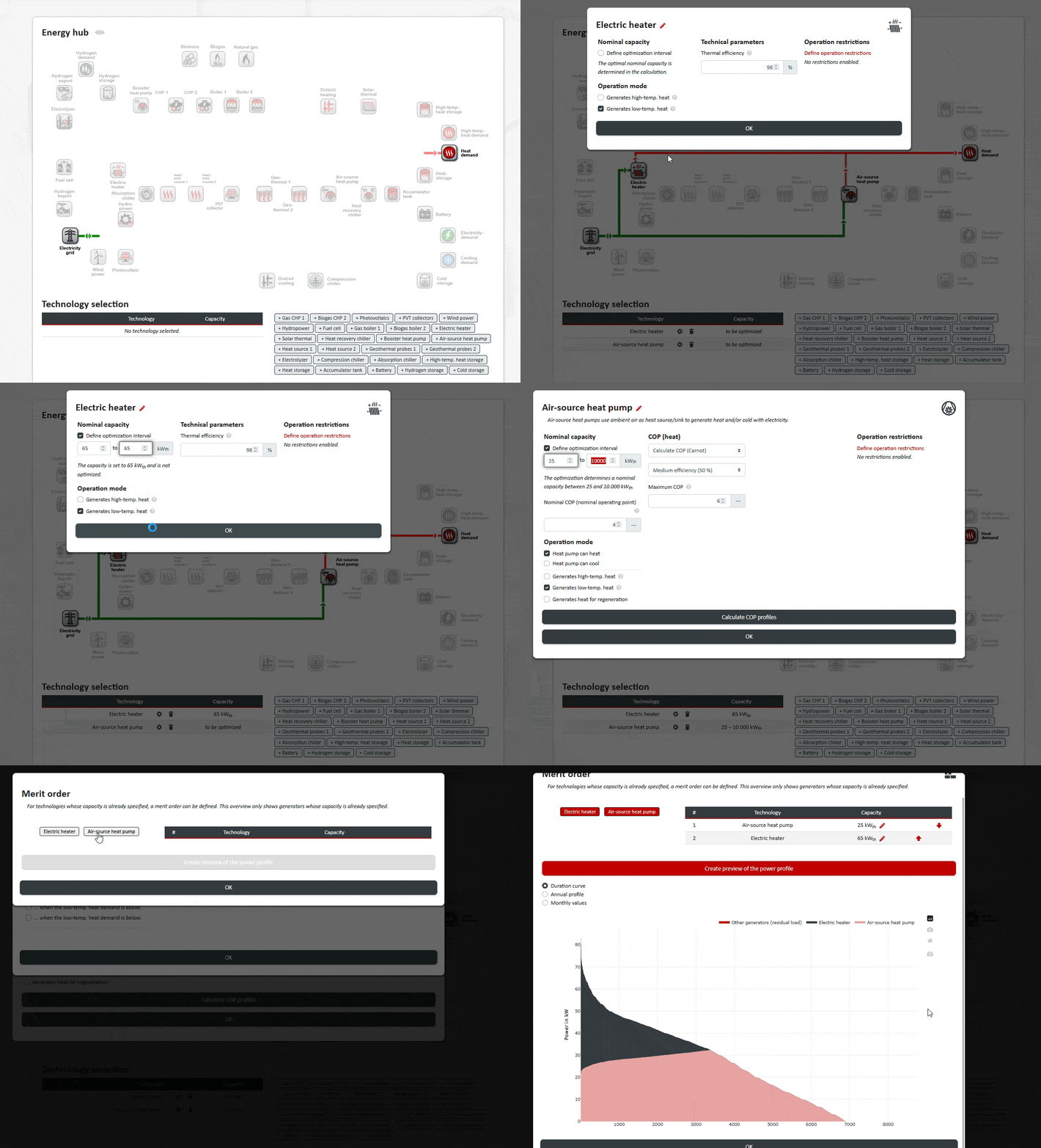
This is how you represent the operating modes (see Figure 3; the example is an energy center project with an already available heating demand):
- Create a project, for example for a single building.
- Have the heating demand calculated or upload a temperature-dependent demand profile.
- Select the air-source heat pump and the electric heating element as generators. Set the nominal capacity of the heat pump such that a coverage contribution remains for the electric heating element. Depending on the operating mode, the further settings differ:
- Bivalent alternative: In the operating restrictions, specify for the peak load generator the outdoor air temperature below which it is to operate, and for the base load generator the outdoor air temperature above which it is to operate.
- Bivalent parallel: Set a bivalence temperature for the electric heater only, below which it is switched on.
- Bivalent partly parallel: In addition to the bivalence temperature of the electric heater, define a cut-off point for the heat pump in its operating restrictions.
- Via the operational restrictions of the heat pump or via the general optimization settings, you reach the merit order and assign the first rank to the heat pump.
Example 2: CHP priority control
For plants with combined heat and power, a fixed technical priority rule often applies in practice: the CHP unit should work as close as possible to its nominal operating point and with long, continuous running times, in order to avoid efficiency losses and wear caused by frequent starts. A peak load boiler must not interrupt this operation and only takes over the demand that the CHP unit cannot cover.
This priority rule applies irrespective of the current electricity or gas price. A purely economic optimizer would temporarily switch off the CHP unit when price conditions are unfavorable – the real plant does not do so, for operational reasons.
With the merit order, you assign the first rank to the CHP unit. The peak load boiler remains free in its nominal capacity and is used by the optimizer to cover the residual load and sized accordingly. In addition, minimum and maximum full-load hours can be specified via the operational restrictions in order to safeguard the intended running time of the CHP unit. Figure 4 shows the annual load duration curve and the optimization result.
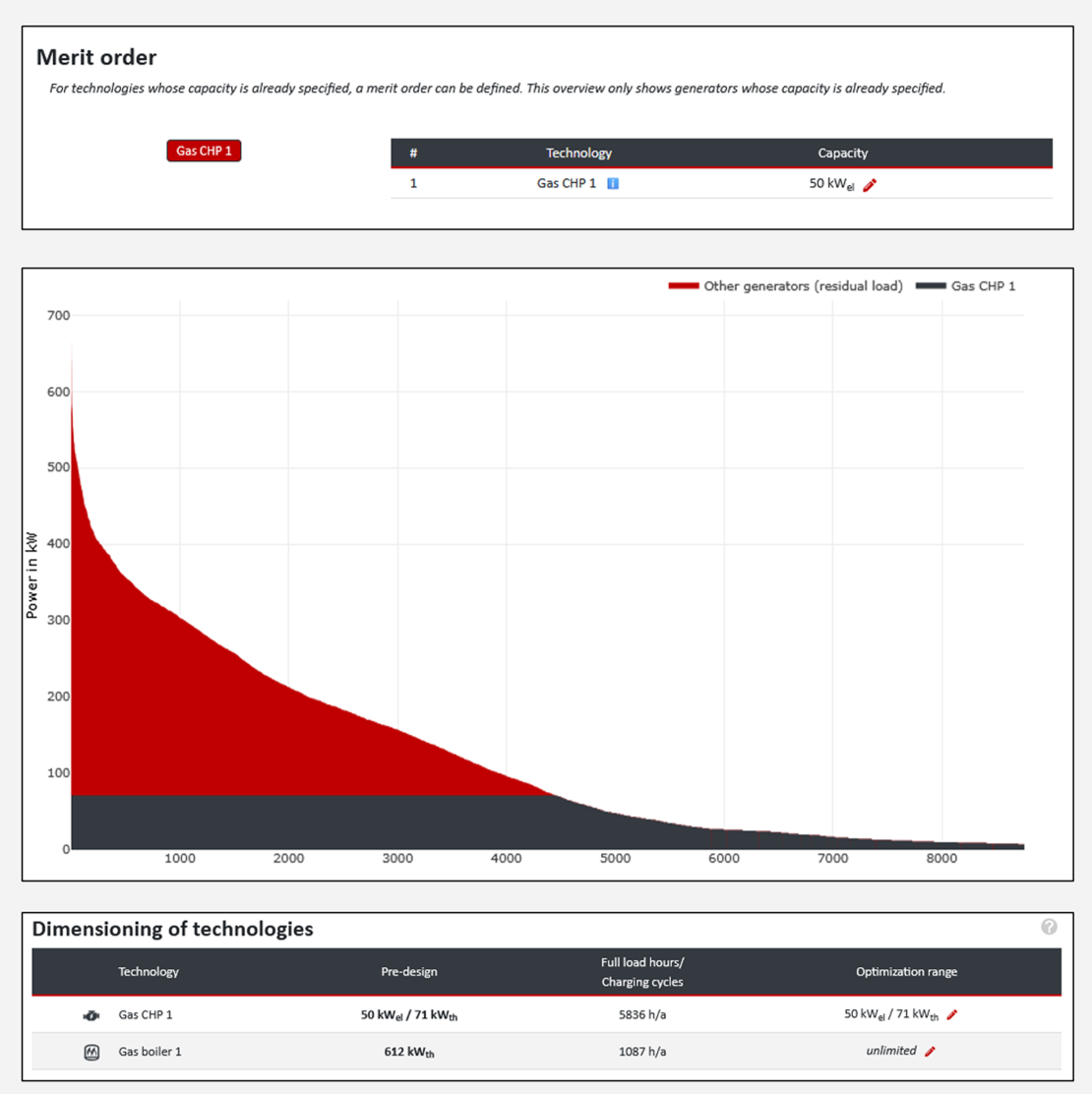
The annual load duration curve makes the division of labor immediately visible: the CHP unit covers the base load over a large part of the year, and the boiler steps in only during the hours of high load. This corresponds to the classic division into base, medium and peak load as is customary in heat supply.
Further use cases
Beyond the two examples, the merit order is suitable wherever operation is to be controlled in a traceable way instead of being run cost-optimally:
- Priority for waste heat: a waste heat source that arises anyway is always to be used first, irrespective of the price situation.
- Existing plants in transition: an existing boiler remains the base load generator for the time being, until it is replaced as part of a transformation plan.
- Traceability towards third parties: a rule-based operating strategy is easier to convey to operators and licensing authorities than the result of an optimization.
If the coverage shares of individual technologies are specified – for example a minimum share of renewable heat – the coverage share of generator groups is often the appropriate tool instead of the merit order. Both specifications can also be combined.