

On this page, you will learn how geothermal energy is modeled in nPro as a heat and cold source – from estimating borehole length and collector area, through the coupled calculation of heat pump and chiller, to modeling seasonal storage operation.
Estimating the length of geothermal boreholes
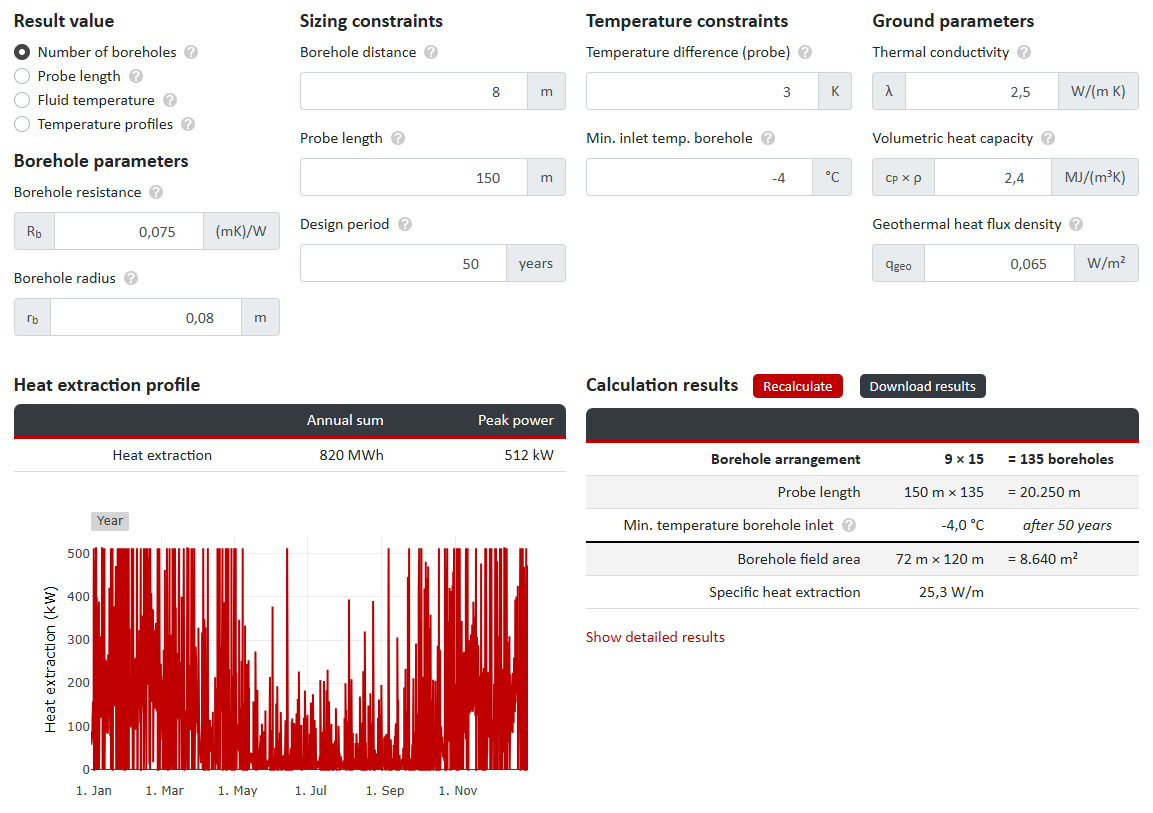
How much heat a borehole can extract from the ground depends on several factors. These include the thermal conductivity of the ground, the number of operating hours (full-load hours), and, where applicable, the influence of neighboring boreholes. The higher the thermal conductivity of the ground, the more heat can flow from the surroundings of the borehole to the borehole, and the more heat can be extracted from the ground. In addition, groundwater flow can increase the heat conduction in the ground. As a distance between two neighboring boreholes, ideally no less than 7 m should be used (minimum: 5 m). The design module for boreholes in nPro is shown in Figure 1.
| Ground type | 1800 full-load hours | 2400 full-load hours |
|---|---|---|
| Gravel, sand, dry | < 25 W/m | < 20 W/m |
| Gravel, sand, water-bearing | 65-80 W/m | 55-65 W/m |
| Clay, loam, moist | 35-50 W/m | 30-40 W/m |
| Boulder clay | 45 W/m | 45 W/m |
Estimating the area of the ground collector
Ground collectors are plastic pipes laid directly beneath the surface of the earth, extracting heat from the ground over an area. The collectors are laid below the frost line, at a depth of approx. 1.2 to 1.5 m. Horizontal ground collectors indirectly make use of solar radiation on the ground surface as well as heat from the ambient air, which penetrates into the subsurface through heat conduction or precipitation. For optimal use, areas with ground collectors should not be built over, so that as much solar radiation and precipitation as possible reaches the surface. For residential buildings, heating with a heat pump typically requires about 1.5 to 2 times the heated floor area. Per kW of heating capacity, around 15 to 30 m² of collector area is needed (depending on the ground conditions).
| Ground type | 1800 full-load hours | 2400 full-load hours |
|---|---|---|
| Dry, non-cohesive soil | 10 W/m² | 8 W/m² |
| Cohesive soil, moist | 20-30 W/m² | 16-24 W/m² |
| Water-saturated sand/gravel | 40 W/m² | 32 W/m² |
Geothermal model for heating and cooling
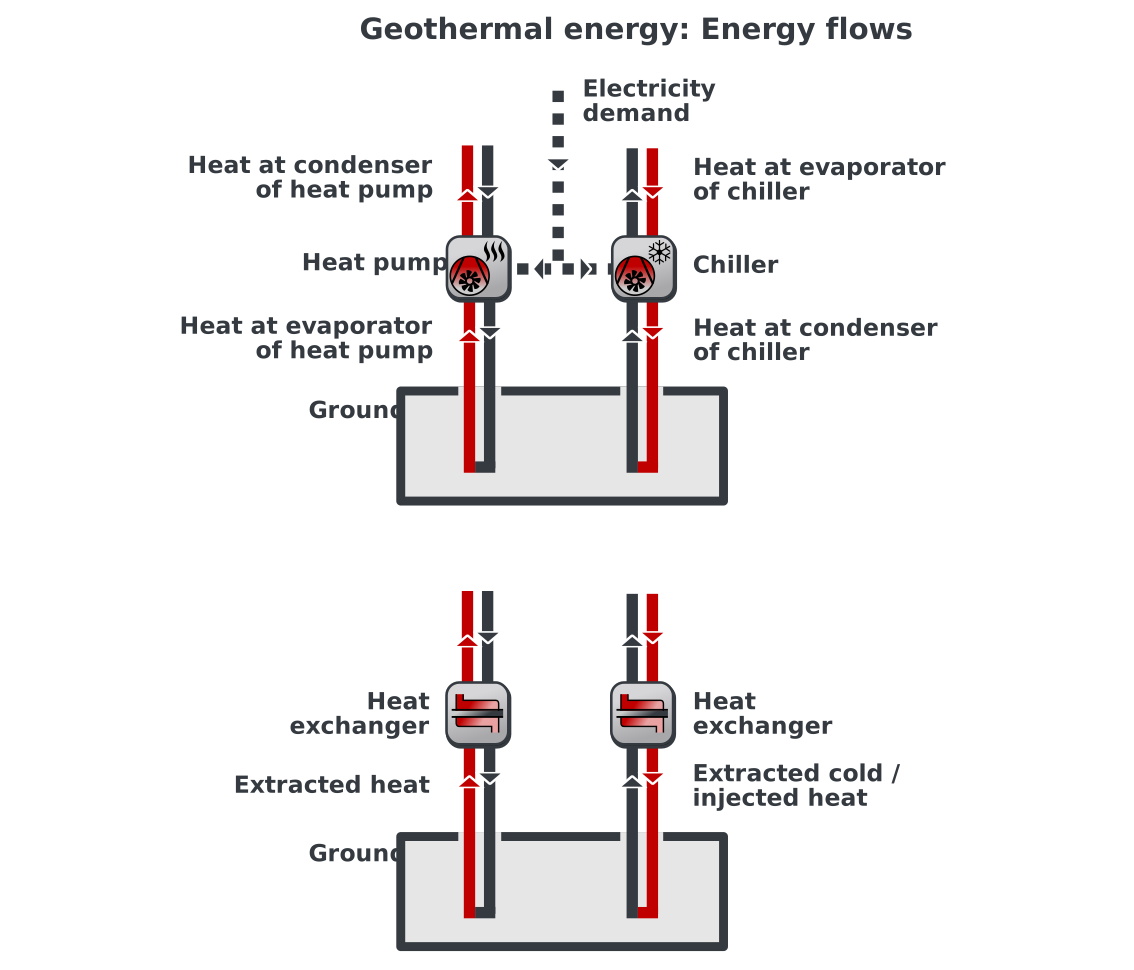
The geothermal model can be used both as a heat source and as a heat sink (cold source). The energy flows of the model are shown in Figure 2. The upper figure shows the energy flows for the case where both a heat pump and a chiller are considered. This case occurs, for example, when a temperature of 40 °C is required to meet the heat demand and a temperature of 2 °C is required to meet the cooling demand, while the temperature of the geothermal source is simultaneously 8 °C. The thermal extraction capacity determined in the design calculation results, when using a heat pump and a chiller, in:
Here, is the annual profile of the evaporator capacity of the heat pump, and is the annual profile of the condenser capacity of the chiller. For the heat at the evaporator of the heat pump, the following applies:
and for the heat at the condenser of the chiller:
Can seasonal storage operation be modeled in the geothermal model?
In the geothermal model, an additional model constraint can be defined that allows seasonal storage operation to be represented. This can, for example, be used for aquifer storage or to represent ice storage. When heat and cooling utilization are both activated in the model, the ratio of heat extracted annually from the ground to heat annually injected into the ground can be defined through the storage cycle efficiency :
For aquifer storage, = 70 % is a commonly used assumption.
Sources
- Planning manual for heat pumps (Viessmann)
- Guide to the geothermal use of the near-surface subsurface
- VDI Guideline 4640: Thermal use of the underground